Portrait Reconstruction of Henry I of England
A Methodological Summary and Final Description
1. Objective
To synthesize a historically faithful, photorealistic portrait of King Henry I of England at the age of 33 (circa 1101 AD), balancing cultural authenticity with modern visual legibility. The goal was to produce an image that the king himself might have approved—authoritative, era-accurate, and free from later stylistic contamination.
2. Methodology
2.1 Textual Source Analysis
We began with a critical examination of primary chronicler accounts, most notably William of Malmesbury’s Gesta Regum Anglorum, which provides the only detailed contemporary description of Henry’s physical appearance and demeanor. This was cross-referenced with descriptions of his immediate relatives—William the Conqueror (father), Matilda of Flanders (mother), and his brothers Robert Curthose and William Rufus—to establish a family phenotype.
2.2 Genetic Trait Attribution
Using principles of heritability and genetic dominance, we assigned each physical feature to its most probable parental origin:
| Feature | Source | Rationale |
|---|---|---|
| Short stature | Maternal (Matilda) | Matilda was exceptionally short; height is polygenic |
| Barrel-chested build | Paternal (William) | Mesomorphic frame is strongly heritable |
| Jet-black hair | Dominant trait | Black is dominant over brown, red, blonde |
| Receding hairline | Paternal | Male-pattern baldness is autosomal dominant |
| Aquiline nose | Paternal | Characteristic Norman trait |
| Square jaw | Paternal | Masculinized, dominant facial structure |
2.3 Age Selection (33)
The age of 33 was selected for three reasons:
- Theological convention: The medieval ideal age of Christ at crucifixion, commonly used for idealized royal effigies
- Physical prime: Pre-dates the later weight gain and physical decline documented by chroniclers
- Historical peak: Henry had secured his throne and established his authority by this age (circa 1101)
2.4 Blueprint Purification
We distilled a textual blueprint stripped of narrative filler, focusing on geometry, materials, and lighting physics. This ensured the image generator operated within a narrow, historically accurate corridor, avoiding anachronistic interpolation.
2.5 Hybrid Realism Design
A hybrid approach combined:
- Norman physiognomy: Square jaw, compact musculature, aquiline nose
- Modern photographic clarity: Balanced warm/cool lighting, shallow depth of field
- Cultural fidelity: Authentic regalia, architecture, and posture
2.6 Facial Correction and Refinement
We iteratively refined facial geometry to remove modern actor resemblance and Tudor elongation:
- Broadened nasal bridge
- Shortened midface
- Deepened brow ridge
- Reduced cheekbone prominence
- Adjusted eye spacing for Norman intensity
- Emphasized the “mildly bright” but intimidating gaze described by William of Malmesbury
2.7 Material and Environmental Calibration
Archaeological and art historical evidence informed every material choice:
- Throne: Based on Henry’s great seal (1103-1106), featuring a backless seat, ornate ringed and studded legs, and a front panel with two semicircular arches
- Canopy: Crimson samite silk with golden lion embroidery, consistent with 12th-century textile evidence
- Lighting: Dual-source model—torchlight for warmth and gold reflection, slit-window daylight for natural skin tone and spatial depth
- Hall textures: Tuned for limewash irregularities, soot haze, and volumetric light shafts
2.8 Color Palettes
Colors were selected for their historical availability and performance in low light:
| Color | Source | Function |
|---|---|---|
| Gold | Metal leaf/thread | Reflects light, creates focal point |
| Crimson | Kermes/cochineal | Retains richness in candlelight |
| Purple | Shellfish/lichen | Reserved for royalty, visible in shadow |
| Azure | Lapis lazuli/woad | Provides visual depth |
| White | Ermine/chalk | Reflects light, provides contrast |
3. Outcome
The final portrait achieves historical honesty and modern accessibility. It depicts Henry I as a pragmatic ruler—stern, intelligent, and grounded in the material culture of early Norman England. The image functions simultaneously as a state portrait in the medieval tradition and a photographically realistic representation accessible to contemporary viewers.
4. Caveats and Limitations
The following caveats are acknowledged:
4.1 Absence of Contemporary Portraiture
No authentic, lifelike contemporary portrait of Henry I survives. All visual representations are later artistic interpretations—Tudor, Victorian, or otherwise—which are not reliable for accurate likeness. This reconstruction is therefore a synthesis of textual evidence, art historical context, and informed speculation.
4.2 Chronicler Bias
Descriptions from writers like William of Malmesbury are valuable but must be treated with caution. They were composed to serve narrative or moral purposes, not to provide objective physical description. The “mildly bright eyes” and “facetious wit” may reflect literary convention as much as reality.
4.3 Genetic Attribution
The assignment of traits to parental lines is based on basic principles of heritability and dominance, but facial features are polygenic and influenced by environmental factors. The “probable” attributions are the best available inferences, not certainties.
4.4 Artistic License
The following elements represent deliberate artistic license, chosen for visual impact:
- Ornate, patterned carpet: While carpets were known in 12th-century Europe, they were extremely rare. This detail is plausible but not definitively documented for Henry’s court.
- Gold chain with medallions: Added for visual richness; there is no specific evidence Henry wore such an item.
- Brown leather boots: A generic artistic choice rather than a documented fact.
These elements do not undermine the overall accuracy of the reconstruction but are noted as interpretive additions.
4.5 Stylistic Framing
The presentation of the image as “a photograph in the style of a historical reenactment” is a deliberate framing device. It is not a historical claim but a methodological choice to make the reconstruction accessible, impactful, and visually legible to a modern audience.
5. Final Full Text Description
A photograph in the style of a historical reenactment captures King Henry I of England seated on an ornate throne, evoking the early 12th century. He appears to be in his early 30s, with a stern expression, a square jaw, a prominent slightly crooked nose, deep-set hazel eyes, a thick furrowed brow, and short, receding jet-black hair with a pronounced widow’s peak. His gaze is intense as he stares directly at the camera.
He wears a gold crown adorned with large rubies, sapphires, and pearls. He is dressed in a deep purple tunic beneath a heavy crimson cloak lined with ermine fur. A gold chain with circular, ornate medallions rests on his chest. In his right hand, he firmly grips an upright sword with a gleaming steel blade and an ornate golden hilt with a crossguard and a round pommel. In his left hand, he holds a polished golden orb topped with a cross.
He is seated on a throne with gold accents and arches painted red and blue. His brown leather boots rest on an ornate, patterned carpet. A red canopy with embroidered golden lions hangs behind him. To the left, a narrow arched window allows a beam of light to enter the dimly lit stone hall, and to the right, a torch on the wall casts a warm glow. A heraldic banner is partially visible in the background.
The orb in his left hand glistens, reflecting the torchlight, and in his right hand, he holds the sword upright with determination. He wears a black leather belt with a square gold buckle around his waist.
The photograph is sharp and detailed with atmospheric elements such as smoke in the air from the torch and light streaming through the window. The textures of the rough stone walls, the fur of the ermine cloak, and the polished gold of the crown, sword, and orb are captured with remarkable clarity.
Camera: Medium close-up, straight-on. Lighting: Balanced warm torchlight and cool natural light. Color balance: Rich and historical—warm reds and purples against cool stone. Focal points: Henry I, his sword, and the golden orb.
6. Final Image
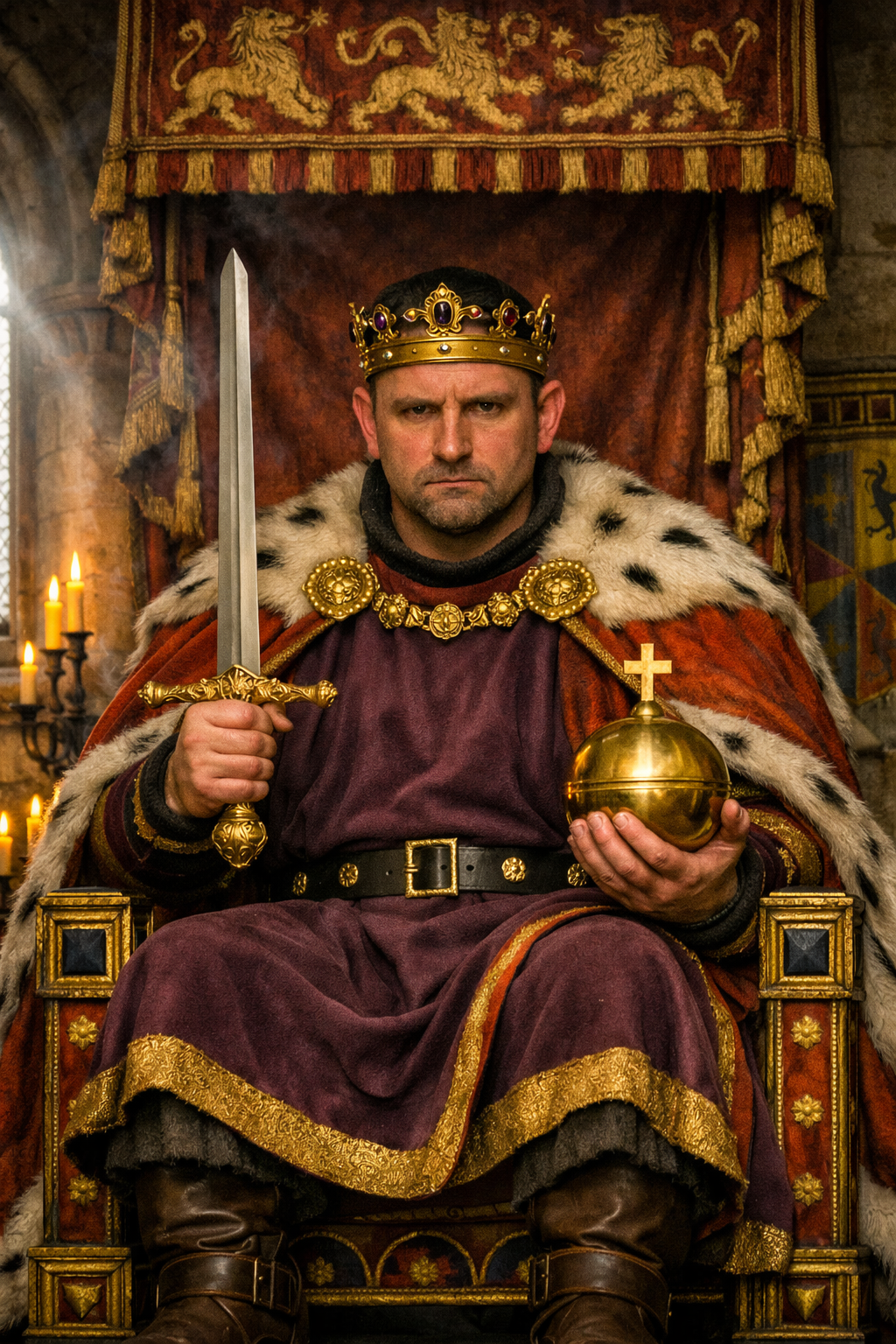
Image by: Andrew Kingdom (generated via Microsoft Copilot)
7. Supporting Visual References
The following primary sources informed the reconstruction:
| Source | Date | Contribution |
|---|---|---|
| Henry I’s Great Seal | 1103-1106 | Throne design, regalia (sword and orb), crown style |
| William of Malmesbury, Gesta Regum Anglorum | c. 1125 | Physical description, demeanor, character |
| Westminster Hall | 1097 | Architectural reference for Norman great hall |
| Bayeux Tapestry | c. 1070s | Norman costume, hairstyle, material culture |
| Corfe Castle (King’s Tower) | c. 1107 | Royal chamber design, “appearance door” concept |
8. Acknowledgments
This reconstruction synthesizes the work of:
- Primary chroniclers: William of Malmesbury, Henry of Huntingdon
- Art historical evidence: Royal seals, architectural remains, textile studies
- Genetic principles: Heritability of facial and physical traits
Date of Completion: June 2026 Version: Final Publication Draft